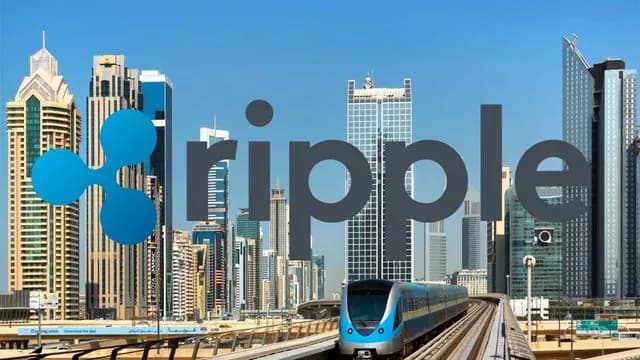
Dubai Brings $5 Million in Property On-Chain as XRP Ledger Powers Regulated Real Estate Trading
Dubai tokenizes $5M in real estate on the XRP Ledger, launching 7.8M tradable property tokens in a regulated market.
Dubai has taken another decisive step toward digitizing its property market, moving more than $5 million in real estate assets onto the XRP Ledger and launching 7.8 million tokenized units now available for regulated secondary-market trading. The initiative marks Phase Two of the emirate’s Real Estate Tokenization Project and reinforces its ambition to position itself at the forefront of blockchain-powered asset innovation.
Led by the Dubai Land Department in collaboration with Ctrl Alt and secured through Ripple Custody, the program allows fractionalized property ownership to be issued and traded directly on-chain. What began as a pilot involving 10 high-value properties worth AED 18.5 million has now evolved into a structured secondary trading framework, transforming tokenized title deeds from static digital records into liquid, tradable instruments.
Robert Farquhar, CEO of MENA at Ctrl Alt, underscored the significance of the shift beyond simple issuance. “Native tokenization only reaches its full potential when assets can move efficiently post-issuance, and secondary market trading is essential to that outcome,” he said. By building infrastructure that supports the regulated transfer of tokenized land title deeds, Farquhar added, Dubai is “setting a global benchmark for how assets can be issued, traded, and managed on-chain.”
Unlike experimental blockchain real estate initiatives elsewhere, Dubai’s approach integrates token activity directly with official land registry systems. Ownership and Asset-Referenced Virtual Asset (ARVA) tokens remain synchronized with government records, ensuring a single immutable source of truth. Secondary trading operates within a controlled pilot environment, aligning blockchain transactions with regulatory oversight rather than circumventing it.
The choice of the XRP Ledger is also strategic. XRPL has established a growing footprint in tokenized real-world assets and, according to market data, commands a significant share of the tokenized U.S. Treasury market, competing with networks such as Ethereum and Solana. Its infrastructure supports secure settlement, low transaction costs, and token escrow capabilities that enable treasury management and automated transfers—features increasingly critical as real-world asset markets scale.
For investors, the implications are substantial. Fractional ownership lowers the capital barrier to entry in one of the world’s most dynamic property markets, potentially broadening participation beyond traditional high-net-worth buyers. Enhanced liquidity, meanwhile, addresses one of real estate’s longstanding inefficiencies: the inability to quickly convert property holdings into cash without complex intermediaries.
More broadly, the project reflects a maturing philosophy around blockchain adoption. Rather than framing tokenization as disruption, Dubai is embedding it within regulated frameworks, balancing innovation with investor protection and governance standards. This alignment could prove decisive in attracting institutional capital wary of unregulated digital asset markets.
As tokenized real-world assets gain traction globally, Dubai’s experiment may offer a template for how governments can responsibly bring property ownership on-chain. By coupling legal clarity with technological infrastructure, the emirate is not merely digitizing deeds—it is reshaping how real estate can be issued, traded, and managed in a blockchain-native economy.