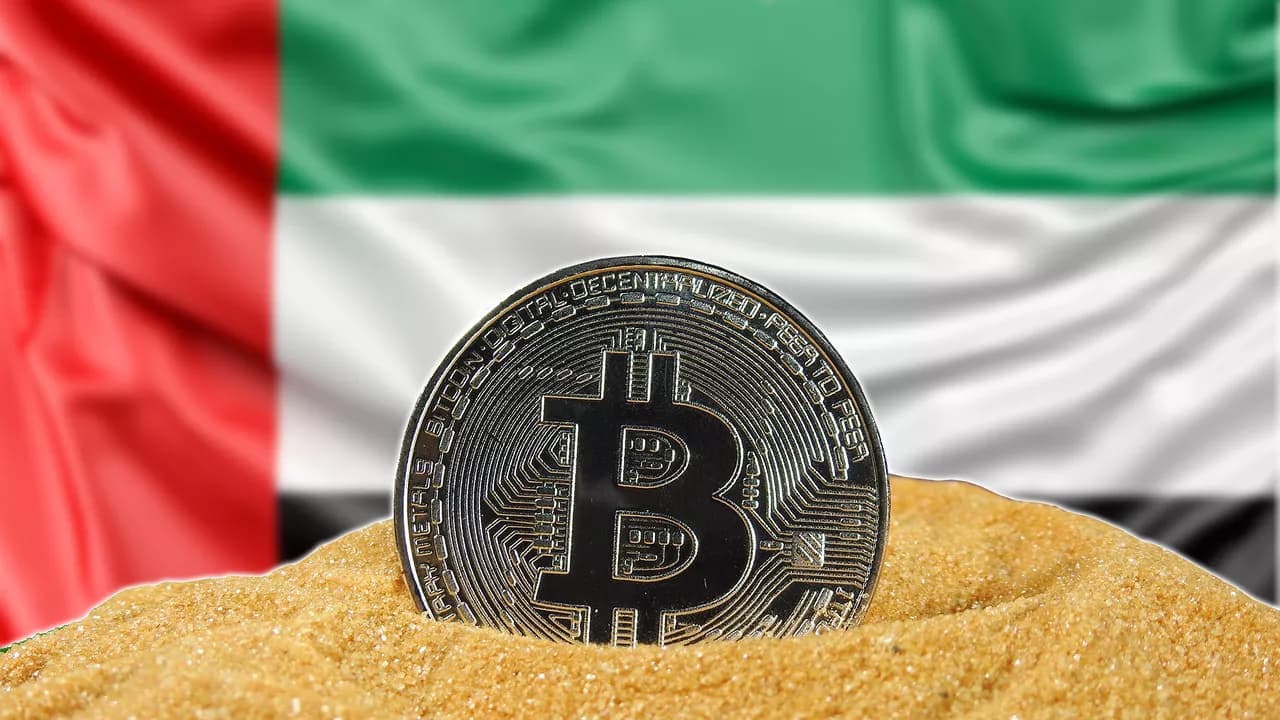
Energy to Assets: How the UAE Quietly Built a $344 Million Bitcoin Windfall
UAE-linked wallets hold 6,782 Bitcoin with $344M unrealized profit, highlighting a sovereign mining strategy over seizures.
The United Arab Emirates has emerged as one of the world’s most consequential sovereign Bitcoin holders—not through seizures or market purchases, but through sustained industrial mining. According to blockchain analytics firmspan>Arkham/span>, wallets linked to the UAE Royal Group currently hold approximately 6,782 Bitcoin, representing around $454 million in assets and roughly $344 million in unrealized profit.
The distinction matters. Unlike governments such as thespan>United States/span> or thespan>United Kingdom/span>, whose Bitcoin reserves largely originate from law enforcement seizures, the UAE’s position reflects a deliberate strategy of infrastructure-backed accumulation. Rather than confiscating digital assets, the country has been converting energy capacity into a growing sovereign crypto reserve.
On-chain data suggests that the UAE’s mining operations continue to generate approximately 4.2 Bitcoin per day, even amid price retracements from late-2025 highs. Excluding energy expenditures, Arkham estimates that the cost basis for these holdings sits well below current market levels, as the coins were mined over multiple years instead of acquired at spot prices.
The roots of this strategy trace back to 2022, when Citadel Mining—linked to Abu Dhabi’s royal family viaspan>International Holding Company/span>—established large-scale mining facilities on Al Reem Island. The effort expanded in 2023 whenspan>MARA Holdings/span> partnered with Abu Dhabi-based Zero Two to deploy 250 megawatts of immersion-cooled mining capacity, one of the Gulf region’s most significant industrial crypto installations.
Arkham first identified the UAE-linked wallets in August 2025, at a time when total mined holdings were estimated near 9,300 Bitcoin, with approximately 6,300 retained. Updated figures reflect both price adjustments and refined wallet tracking rather than substantial liquidation. The most recent notable outflow from UAE Royal Group wallets occurred roughly four months ago, reinforcing the impression of a long-term holding strategy.
At roughly 0.03 percent of Bitcoin’s total supply, the UAE’s reserves are modest compared with Washington’s 328,000 Bitcoin—valued near $22 billion—or Britain’s 61,000 Bitcoin, worth approximately $4 billion. Yet the mechanism of accumulation sets the Emirates apart. The U.S. government’s holdings stem from FBI recoveries tied to events such as the Bitfinex hack and Silk Road seizures, while the U.K.’s position originates from Metropolitan Police confiscations. The UAE, by contrast, appears to be engineering its exposure through production and retention.
The strategy aligns with the country’s broader ambition to position itself at the intersection of energy infrastructure and digital finance. By retaining most of what it mines, the UAE effectively transforms surplus energy capacity into a programmable, globally liquid asset—one that compounds with each newly produced block.
Other sovereign actors are pursuing similar paths, albeit with different outcomes. Bhutan’s Royal Government, through Druk Holding and Investments, began hydro-powered mining in 2019 and at one point accumulated over $1 billion in Bitcoin. Unlike the UAE, Bhutan has recently reduced its position, selling more than $100 million over the past five months.
In a market cycle where many private miners have been forced to liquidate reserves to sustain operations, the UAE’s continued accumulation stands out. It suggests a sovereign approach less concerned with short-term volatility and more focused on strategic asset building. As Bitcoin matures into a macro-relevant reserve asset, the Emirates’ experiment in energy-backed digital accumulation may offer a preview of how resource-rich states diversify for a post-oil future.