FedEx Joins Hedera Council in Strategic Push Toward Digitally Native Global Supply Chains
FedEx joins Hedera Council, aiming to modernize global supply chains through distributed ledger governance and node operation.
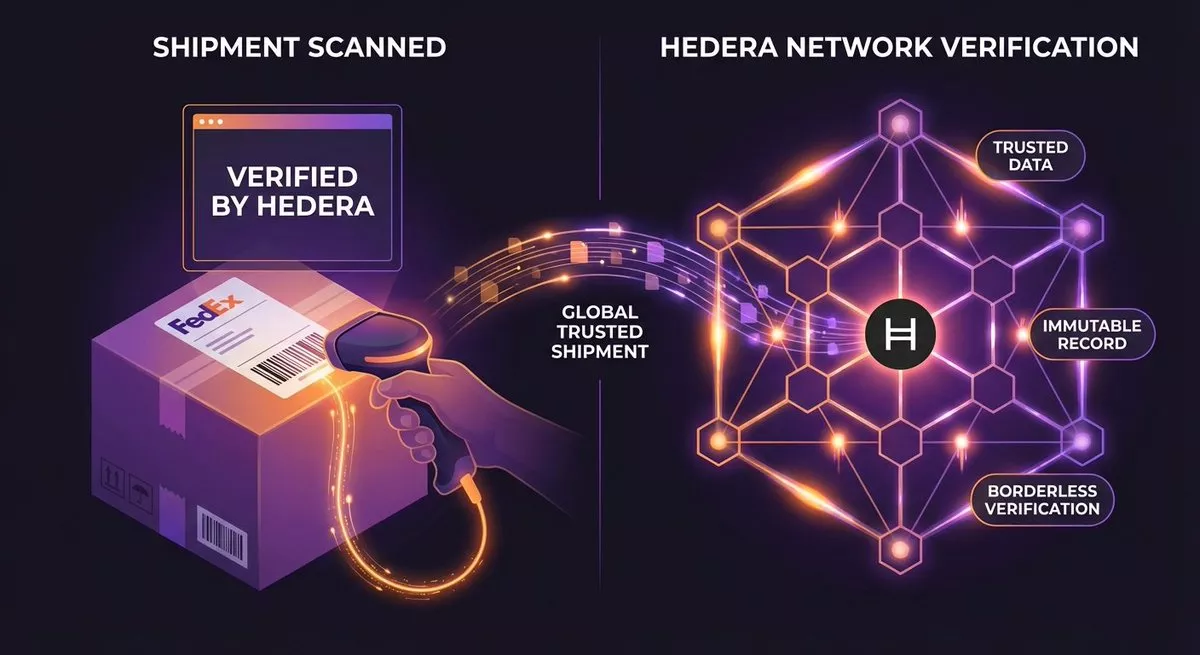
FedEx Corp. has taken a formal step into distributed ledger governance, joining the Hedera Council as it seeks to accelerate the digital transformation of global supply chains. The logistics giant will operate a network node and participate in governance decisions for the Hedera network, aligning itself with a roster of major corporations already involved in the council.
The move places FedEx alongside firms such as Google, IBM, Dell Technologies, LG, Deutsche Telekom, and Ubisoft, all of which contribute to the oversight and strategic direction of the Hedera distributed ledger. For FedEx, the decision reflects more than symbolic support for blockchain infrastructure. It signals a strategic calculation that distributed ledger technology could underpin the next phase of global commerce.
“The digital transformation of global supply chains is inevitable,” said Vishal Talwar, executive vice president and chief digital and information officer of FedEx Corp., in a statement announcing the partnership. He emphasized that as supply chains become “increasingly digital-native,” trusted data must be verified across multiple stakeholders without concentrating control in a single entity.
That framing captures a long-standing promise of blockchain and distributed ledger systems: enabling secure, verifiable data exchange among parties that may not fully trust one another. In industries dependent on complex international logistics, documentation, customs verification, and multi-party coordination, inefficiencies often stem from fragmented data silos and paper-based processes. Hedera positions its network as a neutral, enterprise-grade trust layer capable of verifying transactions and records at scale.
Through its council membership, FedEx will not merely observe but help shape governance decisions. Running a network node grants the company direct participation in transaction validation and network resilience. Governance involvement also means influencing protocol upgrades, standards development, and ecosystem priorities.
Hedera Council President Tom Sylvester welcomed the addition, noting that FedEx brings “deep operational insight into global logistics and commerce.” That expertise could prove valuable as distributed ledger initiatives attempt to move beyond pilot programs toward industry-wide implementation.
While the announcement underscores enterprise confidence in blockchain-adjacent infrastructure, market response to Hedera’s native token, HBAR, was muted. The token hovered near $0.094 following the news, reflecting modest short-term volatility even as it remains significantly below its 2021 peak. For enterprises like FedEx, however, the strategic value lies less in token price movements and more in infrastructure reliability and interoperability.
Corporate adoption has long been viewed as a critical milestone for distributed ledger networks. Yet meaningful transformation depends on integration into real-world operations. FedEx’s involvement suggests that logistics leaders are increasingly willing to test governance participation rather than limiting engagement to surface-level experimentation.
As supply chains confront geopolitical fragmentation, regulatory scrutiny, and growing demand for real-time transparency, digital verification layers may become foundational rather than optional. FedEx’s entry into the Hedera Council indicates that legacy logistics firms are not waiting for that transition to be mandated. They are positioning themselves to help design it.