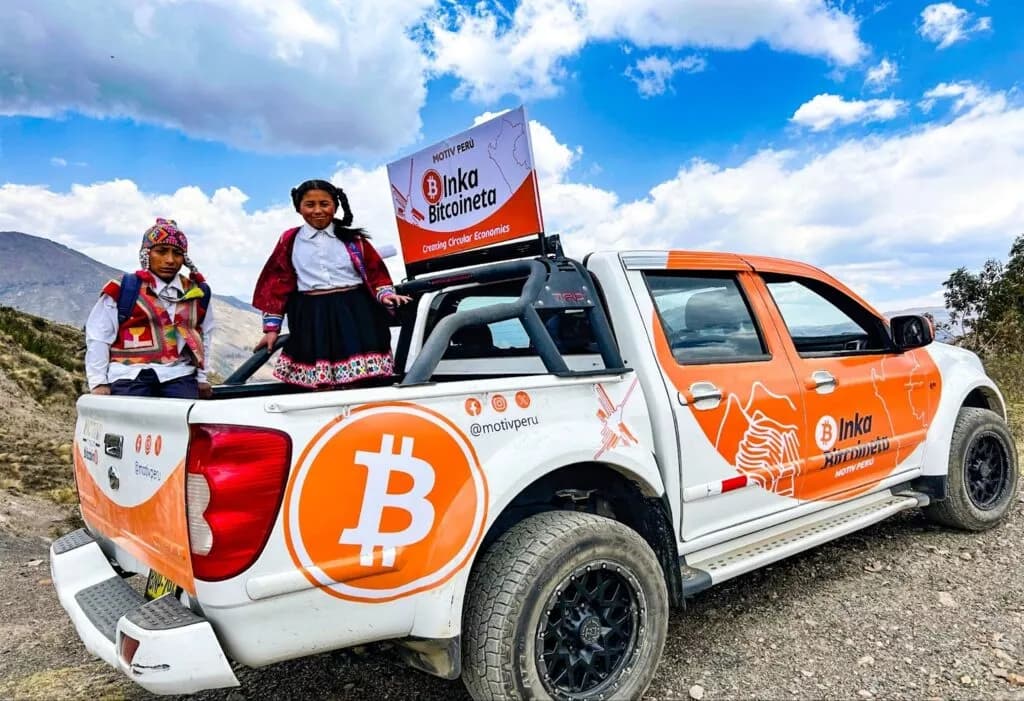
From Alpaca Socks to Digital Sovereignty: How Motiv Is Turning Bitcoin Into a Lifeline for Peru’s Forgotten Communities
How Motiv Peru uses Bitcoin to build circular economies and support 750+ families weekly across the country.
Across Peru’s vast geography—from the Andean highlands to Amazonian outposts—Bitcoin is not arriving through government decrees or corporate pilots. It is spreading through food drives, shoe donations and community workshops. At the center of this quiet transformation stands Motiv Peru, a non-profit that has evolved from a modest charity initiative into one of Latin America’s most compelling experiments in Bitcoin-powered circular economies.
Co-founded in 2019 by Rich Swisher, a retired U.S. military and police officer, and Valentin Popescu, a Romanian humanitarian who has lived in Peru since 2007, Motiv began with something deceptively simple: shoes. The “Happy Steps” program was born after Popescu met Jonathan, a seven-year-old orphan in a remote Cusco village. “This is the orphan of the village, the most looked-down-on kid… and he’s thinking about others,” Popescu recalled, describing how the boy shared a granola bar despite his hunger. “My mind, my heart exploded.”
What started as a mission to provide durable footwear—essential in mountainous terrain where children walk long distances to school—has grown into a network spanning roughly 10 active zones, with hubs in Lima, Cusco and Huanchaco. Today, Motiv reaches more than 750 families weekly and operates with a team of 50 staff and volunteers.
The turning point came in 2020. As COVID-19 ravaged Peru’s economy, Motiv needed to pivot from shoes to food. Traditional donors refused to reallocate funds earmarked for specific purposes. Then came an unconventional offer: a Bitcoin donor willing to finance both shoes and emergency supplies, on one condition—everything had to be paid in Bitcoin.
“This isn’t the time for jokes,” Popescu initially told Swisher. But the offer was real. The challenge was practical: few merchants accepted Bitcoin. Motiv began persuading local vendors, starting with a kiosk owner and later Olger, a shoemaker devastated by the pandemic. Widowed and unemployed, Olger rebuilt his livelihood by teaching others his craft and accepting Bitcoin payments from Motiv. His workshop became a cornerstone of what would soon resemble a functioning circular economy.
Rather than evangelize financial revolution, Motiv adopted a pragmatic approach. Bitcoin was introduced not as a speculative asset or ideological statement, but as a payment rail. In a country scarred by financial scams, simplicity mattered. Merchants were shown how to use wallets such as Blink, and education followed organically. As Popescu puts it, leadership is not rhetoric but service: “Being a leader isn’t talking; it’s serving.”
The results are tangible. By 2025, Latin America had become one of the world’s fastest-growing crypto regions, with Peru processing an estimated $28 billion in transaction volume. Against that backdrop, Motiv’s grassroots strategy stands out. In 2025 alone, its programs reached more than 6,000 people through educational fairs, community events and even a Copa Bitcoin football tournament. Cumulatively, between 25,000 and 30,000 individual Bitcoin transactions have flowed through its ecosystem.
Motiv’s model revives an early Bitcoin ideal—“banking the unbanked”—but strips it of techno-utopian rhetoric. Instead of parachuting in foreign aid, it nurtures local supply chains, trains merchants and embeds digital payments into daily life. In doing so, it demonstrates that financial sovereignty in emerging markets may not begin in boardrooms or legislatures, but in villages where a pair of sturdy shoes can open the door to school—and where a digital wallet can anchor a community’s economic future.