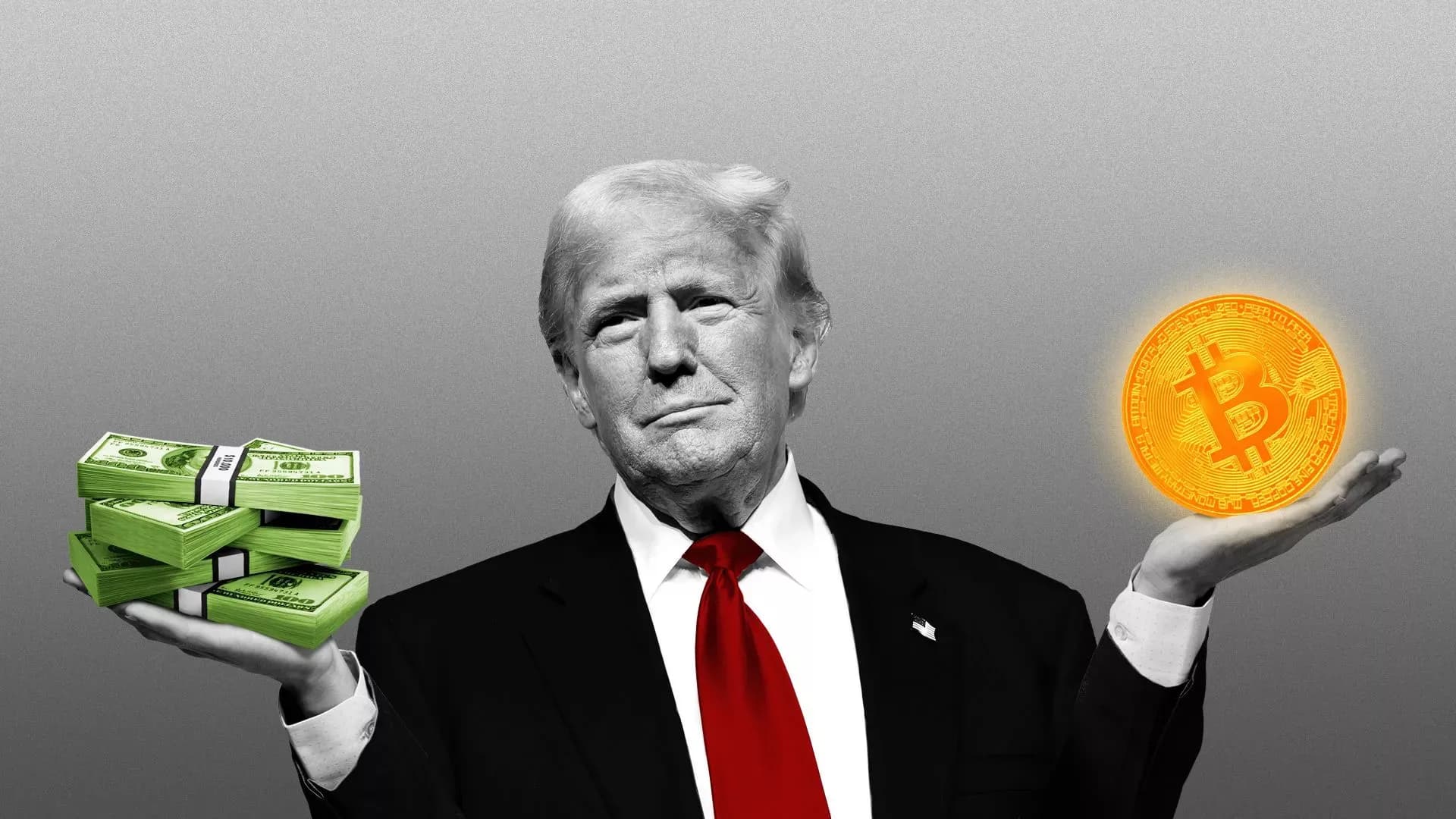
Markets Recoil as Trump’s Tariff Ultimatum Jolts Currencies and Sends Bitcoin Sliding
Bitcoin slid and the dollar weakened as Trump’s tariff threats against Europe sparked a global risk-off move and sent investors into safe havens.
Global markets turned defensive on Monday after renewed tariff threats from Donald Trump reignited fears of a transatlantic trade conflict, prompting investors to retreat from risk assets and seek shelter in traditional safe havens. The ripple effects were felt across currencies, commodities and cryptocurrencies, with Bitcoin retreating sharply as uncertainty spread.
The latest bout of volatility followed Trump’s weekend announcement that the United States would impose an additional 10% import tariff from February 1 on goods from a broad group of European countries, including Denmark, Germany, France, the UK and several Nordic nations. The measures, he said, would remain in place until Washington is permitted to purchase Greenland, an escalation that immediately unsettled investors and policymakers alike.
Currency markets were among the first to react. The U.S. dollar weakened as capital rotated into perceived havens such as the Swiss franc, which was on track for its strongest daily gain against the greenback in a month. The euro and the pound also advanced, a counterintuitive move that underscored how political uncertainty in the United States is increasingly weighing on dollar sentiment. By midday in Europe, the euro was trading around $1.163, while sterling hovered near $1.34.
“Typically you would think tariffs being threatened would lead to a weaker euro,” said Khoon Goh, head of Asia research at ANZ. Yet, he noted that recent history suggests otherwise, arguing that heightened policy uncertainty emanating from Washington has repeatedly translated into dollar weakness rather than strength. The pattern, observed during last year’s so-called “Liberation Day” tariffs, appears to be reasserting itself.
European leaders moved quickly to contain the fallout. Over the weekend, officials agreed to intensify diplomatic efforts to prevent the tariffs from taking effect, while simultaneously preparing retaliatory measures should negotiations fail. The prospect of a broader trade confrontation, however, continued to loom over markets.
Cryptocurrencies mirrored the risk-off mood. Bitcoin, often treated as a high-beta proxy for investor sentiment, fell around 2.5% to just above $93,000, while ether dropped more than 3% to roughly $3,223. The sell-off suggested that, despite occasional narratives framing digital assets as hedges against political turmoil, they remain vulnerable during periods of acute uncertainty.
Not all analysts are convinced that the dollar’s defensive role is fading permanently. Jane Foley, chief currency strategist at Rabobank, cautioned against writing off U.S. assets too quickly. She argued that the depth and scale of American financial markets continue to confer a degree of safe-haven status that few alternatives can match, even if confidence has been shaken since last April’s global tariff announcements.
In Asia, the Japanese yen offered a more muted response. Although traditionally a refuge in turbulent times, the currency has been weighed down by domestic political uncertainty and expectations of fiscal stimulus ahead of a possible snap election. With the yen trading near its weakest level since mid-2024, analysts warned that the risk of official intervention remains elevated.
For now, markets appear caught between two competing forces: a growing unease over U.S. trade policy and the enduring gravitational pull of American assets in times of stress. Until clarity emerges, volatility across currencies and digital assets is likely to remain a defining feature of the trading landscape.