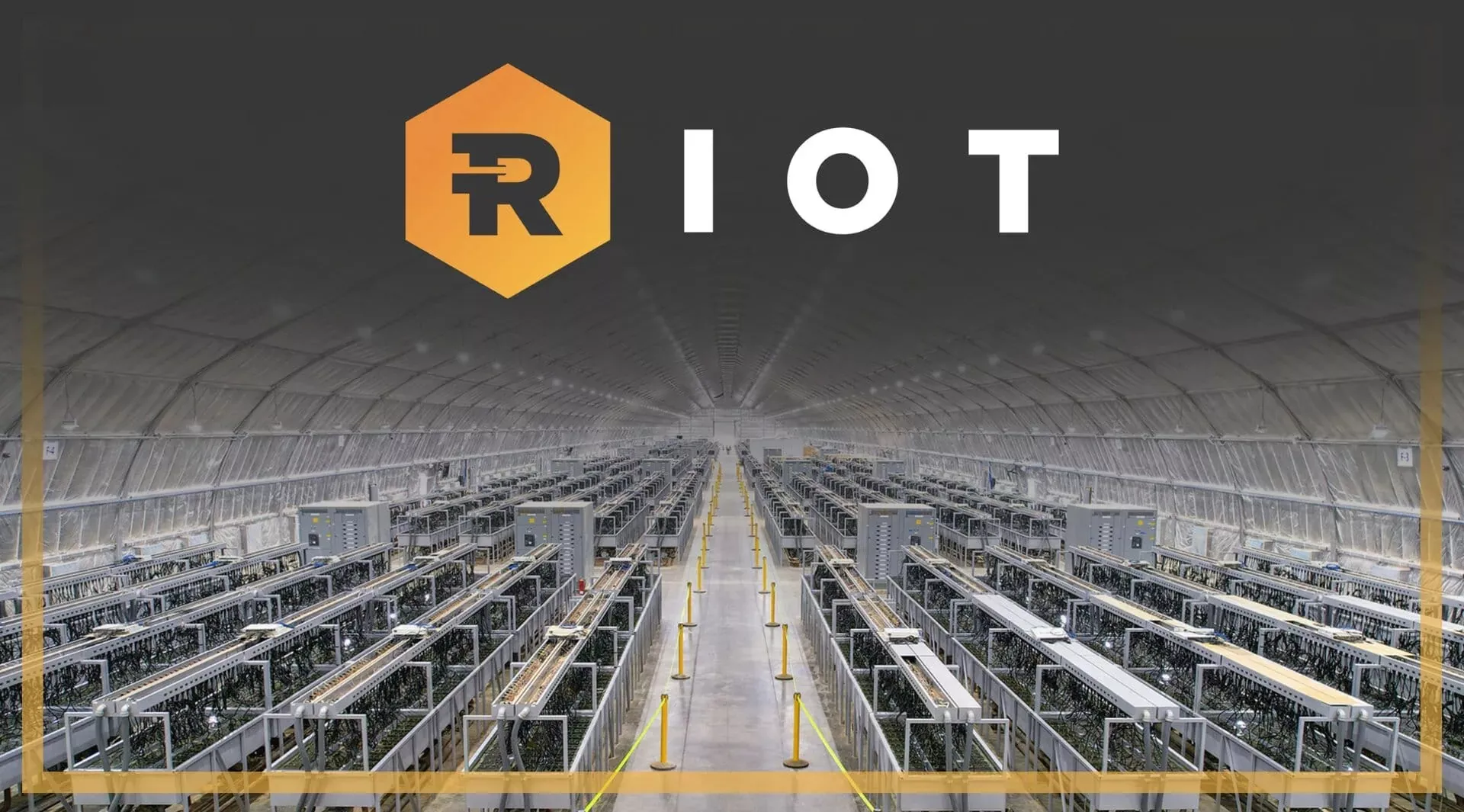
Riot Platforms Reframes Its Bitcoin Strategy as Wall Street Rewards a Texas Data Center Bet
Riot Platforms shares jumped after the miner sold Bitcoin to fund a Texas data center deal, signaling a strategic pivot toward AI infrastructure.
Riot Platforms’ stock surged more than 11 percent after the company disclosed that it had sold part of its Bitcoin reserves to finance a major land acquisition and data center expansion in Texas, underscoring a broader strategic pivot underway across the crypto mining industry.
The Nasdaq-listed miner announced that it had completed a $96 million purchase of 200 acres in Rockdale, Texas, a deal funded entirely through the sale of approximately 1,080 Bitcoin. The transaction follows Riot’s disclosure last week that it had liquidated more than $160 million worth of Bitcoin as part of a deliberate shift away from a singular focus on mining and toward maximizing the value of its data center infrastructure.
Alongside the land acquisition, Riot revealed a long-term data center lease and services agreement with semiconductor giant Advanced Micro Devices. Under the initial phase of the deal, Riot will deploy 25 megawatts of critical IT load capacity, signaling its intention to position itself as a serious player in the rapidly expanding markets for artificial intelligence and high-performance computing.
Riot’s chief executive Jason Les framed the announcement as a turning point for the company. “These results mark a pivotal moment that cements Riot’s position as a leading data center developer,” he said, noting that less than a year has passed since the company formally began evaluating how its assets could be repurposed for AI and HPC workloads. The emphasis on speed is notable, reflecting mounting pressure on miners to adapt as Bitcoin mining economics grow more competitive.
According to Riot, the AMD agreement carries an initial 10-year term and could generate approximately $311 million in revenue. If three optional five-year extensions are exercised, total revenue could exceed $1 billion. Investors responded swiftly, pushing Riot shares to around $18.80 and delivering a double-digit gain within 24 hours of the announcement.
The market reaction highlights a growing recognition that large-scale mining operators possess assets that extend beyond Bitcoin production. Access to land, power infrastructure, and cooling systems has become increasingly valuable as demand for AI data centers surges across the United States. For Riot, selling Bitcoin to unlock that value represents a pragmatic recalibration rather than a retreat from crypto.
Last week, the company disclosed that it sold 1,818 Bitcoin in December, reinforcing its intention to redeploy capital into infrastructure with more predictable long-term returns. Despite those sales, Riot reported holding 18,005 Bitcoin at the end of December, a reserve that still places it among the largest corporate holders of the asset.
Riot is not alone in pursuing this path. CleanSpark recently announced plans to acquire 447 acres in Brazoria County, Texas, with the goal of developing a 300-megawatt data center capable of supporting AI and high-performance computing workloads. Other major mining firms, including MARA Holdings, Core Scientific, Hut 8, and TeraWulf, have also outlined strategies aimed at diversifying beyond pure Bitcoin mining.
Together, these moves reflect an industry responding to rising mining difficulty and tighter margins by leveraging its infrastructure for broader digital applications. Riot’s Texas deal suggests that, for investors at least, the strategy is gaining credibility. Rather than abandoning Bitcoin, the company appears to be redefining how it monetizes the ecosystem built around it.