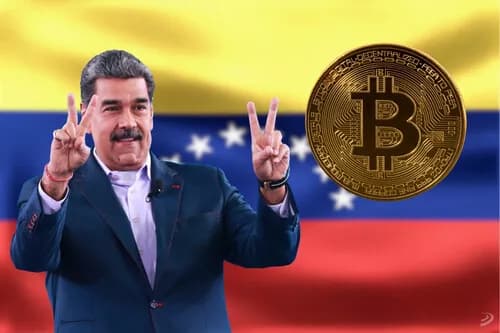
Venezuela’s Shock Power Shift Revives Claims of a Hidden Bitcoin Stockpile
Maduro’s arrest has revived claims that Venezuela secretly amassed up to 600,000 Bitcoin, raising questions about hidden sovereign crypto reserves.
The arrest of Nicolás Maduro by U.S. authorities has triggered more than a geopolitical earthquake. It has reignited long-simmering questions about whether Venezuela, after years of sanctions and financial isolation, quietly amassed one of the world’s largest sovereign Bitcoin reserves. While the claims remain unproven, the timing of Maduro’s detention has pushed this speculative narrative back into the spotlight, unsettling markets and policymakers alike.
Official data tracking sovereign and corporate Bitcoin treasuries currently attribute only around 240 BTC to the Venezuelan state, a relatively modest figure worth tens of millions of dollars at prevailing prices. Yet alternative estimates paint a far more dramatic picture. According to blockchain intelligence group Whale Hunting, Venezuela’s actual holdings could be as high as 600,000 Bitcoin, a sum that would represent nearly 3% of the asset’s circulating supply and imply a notional value approaching $60 billion. These figures are based on indirect evidence and remain unverified, but their implications are hard to ignore.
Analysts linking the alleged reserve to Venezuela’s sanctions-era survival strategies argue that crypto became a parallel financial lifeline when access to traditional systems narrowed. One frequently cited theory suggests the government converted physical gold extracted from the Orinoco Mining Arc into Bitcoin, with one reported tranche of purchases estimated at roughly $2 billion executed when prices hovered near $5,000 per coin. If accurate, such timing would mean the position has multiplied in value many times over.
Separate reports reinforce the idea that digital assets played a broader role in Venezuela’s workaround economy. Buyers of Venezuelan oil were, according to multiple accounts, asked by the state oil company to settle some transactions in Tether rather than through banks vulnerable to sanctions enforcement. While USDT is not Bitcoin, its alleged use supports the view that Caracas leaned heavily on crypto rails to keep trade flowing outside conventional oversight.
Ironically, these claims contrast sharply with domestic policy moves taken in recent years. Venezuelan authorities banned Bitcoin mining, seized thousands of ASIC machines citing energy strain, and formally discontinued the Petro, the state-backed token once promoted as a sanctions-evasion tool. To critics, this crackdown suggests contradiction; to proponents of the hidden-reserve thesis, it reflects consolidation and tighter control rather than abandonment.
The legal implications of Maduro’s arrest add another layer of complexity. Should U.S. investigators identify wallets credibly linked to Venezuelan state entities, any Bitcoin held there would likely face a prolonged legal process rather than immediate liquidation. Such a freeze could effectively remove a significant volume of supply from active circulation, muting fears of a sudden sell-off while introducing a new source of long-term uncertainty for the market.
For now, Bitcoin traders appear unfazed. Risk sentiment remains firm, and the episode has not derailed broader bullish momentum. Still, the possibility that a sanctioned state quietly accumulated a massive, undisclosed Bitcoin position underscores how opaque sovereign crypto exposure remains. Whether the rumored Venezuelan hoard proves real or exaggerated, the episode highlights a new reality: in a world of digital assets, geopolitical shocks can surface financial narratives that markets have yet to fully price in.