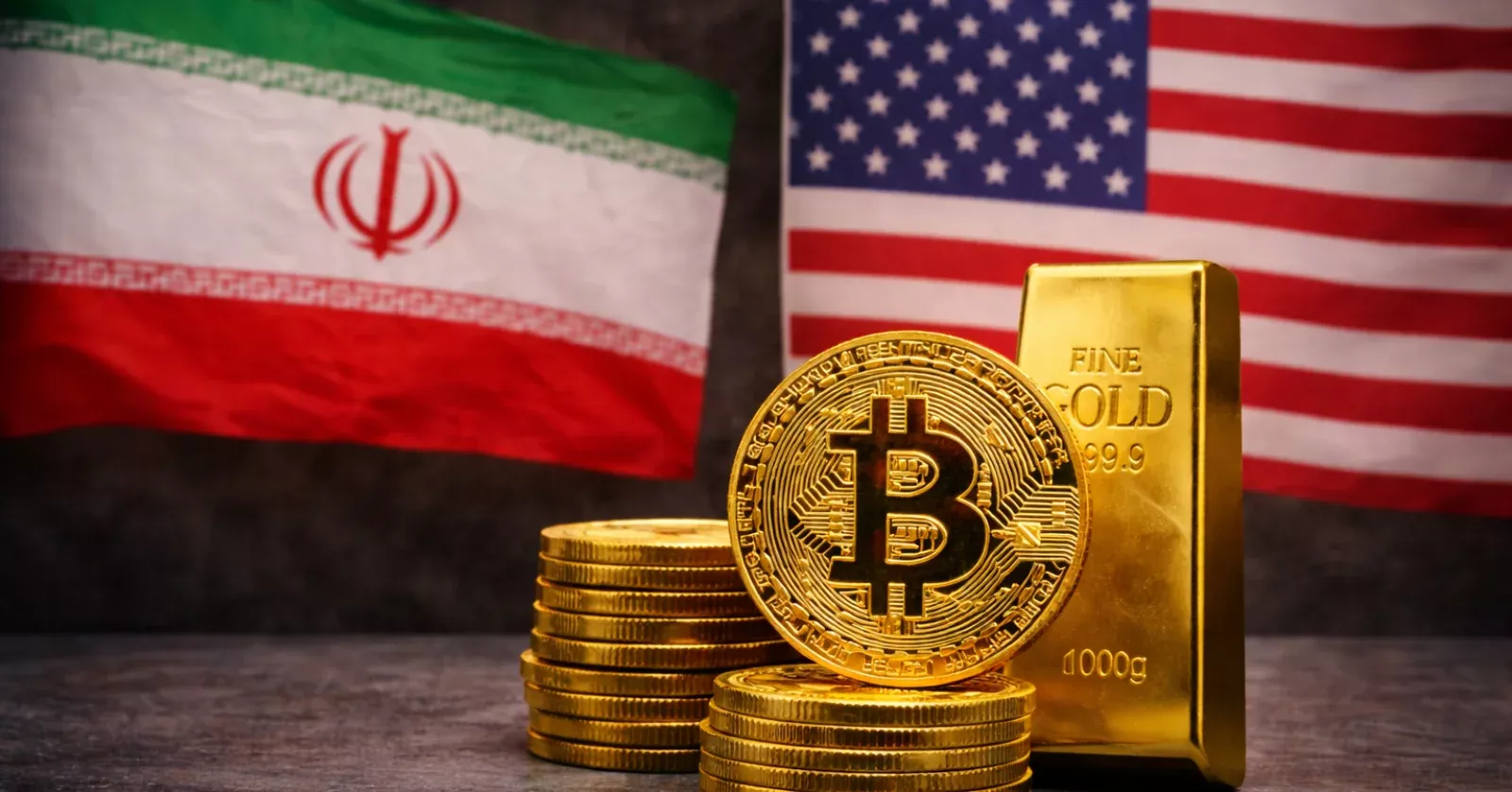
When Crisis Strikes the Middle East Investors Flee to Gold and Abandon Bitcoin
Gold surges and bitcoin drops after Iran shock, highlighting crypto’s struggle to act as a safe-haven asset.
Global markets were jolted into volatility after reports confirmed that Iran’s Supreme Leader had been killed in a surprise joint airstrike carried out by the United States and Israel. The geopolitical shock sent investors scrambling for safety, triggering a familiar pattern across asset classes: gold surged, while bitcoin retreated sharply.
Precious metals reacted first. Gold futures climbed as high as $5,464 per troy ounce in over-the-counter trading, marking a four percent jump from the previous New York session close. Silver followed, rising toward the psychologically significant $100 level. The spike reflected classic safe-haven behavior, as capital rotated rapidly into assets historically perceived as stores of value during geopolitical instability.
By contrast, bitcoin once again behaved less like digital gold and more like a high-beta risk asset. Data fromspan>CoinMarketCap/span> showed bitcoin sliding to approximately $63,245, down more than six percent in a 24-hour window. On South Korea’sspan>Bithumb/span>, the decline was similarly pronounced, underscoring how global crypto markets remain highly sensitive to macro shocks.
The divergence reinforces a recurring theme in 2026’s market narrative. Despite its branding as an inflation hedge or geopolitical shield, bitcoin has repeatedly sold off during episodes of global stress. Asspan>Bloomberg News/span> observed, each major geopolitical flashpoint this year — from tensions in Ukraine to instability in Venezuela — has prompted investors to rotate into traditional safe havens rather than digital assets.
Attention now shifts to equities. Market participants are closely watching thespan>New York Stock Exchange/span> for directional signals. Its performance could shape sentiment in Asia, particularly in South Korea, where trading resumes shortly. The benchmark KOSPI index has already shown signs of strain, closing down one percent in its last session amid heavy foreign net selling.
Analysts warn that sustained geopolitical uncertainty could trigger a broader correction phase. Foreign investors may accelerate capital outflows from emerging markets, reallocating funds into the U.S. dollar and other perceived safe assets. Noh Dong-gil ofspan>Shinhan Securities/span> noted that with speculation surrounding potential regime change in Iran, forecasting a swift rebound in Korean equities remains difficult.
Yet not all outlooks are uniformly bearish. Some strategists argue that the domestic rally driven by semiconductor giants such asspan>Samsung Electronics/span> andspan>SK hynix/span> may retain structural support, as export fundamentals appear insulated from immediate geopolitical fallout.
The episode underscores a broader recalibration in how markets interpret bitcoin’s role. While crypto advocates continue to frame it as digital gold, price action suggests that institutional investors still classify it within the risk spectrum. In moments of acute uncertainty, liquidity preference dominates ideology.
Whether bitcoin can eventually decouple from risk cycles remains an open question. For now, the Middle East shock has reinforced a long-standing hierarchy in crisis investing: when geopolitical tension rises abruptly, bullion glitters brighter, and digital assets dim.